Chronic Illnes, For Family & Friends

So This is the New Year….

I’m proud of my wife.

This isn’t an effort to win points in some imaginary husband contest or to impress the Internet with how thoughtful I am. There is no scoreboard in a relationship and if there is, you should probably run away from that situation with haste.

No, I’m just stating a fact. I’m proud of her intelligence and grace under pressure. Her gentle touch when handling problems. And of course, her ability to navigate the uneasy waters of chronic illness.

I myself am a less reliable captain of my own vessel. I have a tendency to lose focus and drift off course. I find myself making questionable choices in the face of difficulty or simply serving as an unreliable narrator in my own story.

I for example rarely know what day it is without looking it up and I’ve always struggled with remembering the current year. That was frequently a situation in the before times. I suspect it’s a permanent state for me now after nearly two years of pandemic life.

There are also my semi-frequent excuses which can easily lead to a trend of bad behavior.

‘I can eat this. I can drink that. It doesn’t matter I’m screwed either way.’

This is a comfortable mindset to fall into when burdened by the weight of genetics.

My family history strongly suggests that I’ll either live to be ancient and lose all mental faculties during my waning years, or—and this is more likely—go out due to heart disease just about the time I’m eligible to collect social security payments.

Given that, it’s not hard at all to throw my hands in the air and do whatever I like.

Except it’s not quite that simple.

I have a great wife and plenty of family who care about me, even if it feels like it’s getting smaller as the years go by. At the risk of sounding full of myself, the world is unquestionably better with me in it and I can line up dozens of witnesses to attest to that your honor.

I’ve thought about this quite a bit recently after a death in my family and another on my wife’s side of things. It’s true that we can’t outrun genetics or consume some magic elixir to cure what ails us. We do however have the ability to take control of the things that are in our power to control.

Whether it’s getting some more exercise or just showing a little restraint in our diets, there are plenty of choices we can make daily to improve our standing in the cosmic calculus of life and death.

This is not however a call to action to live a clean and virtuous life. That friends is for suckers.

Take some chances, indulge yourself every now and then. Eat some cake, have too many drinks, spend an entire weekend without putting on real pants or leaving the couch. Life without these things mixed in once in a while isn’t the rich tapestry we deserve.

All work and no play makes Jack a real dull bastard, ya know?

The turning of the calendar into a new year can be a daunting time to make changes. I hate it myself, partly because it’s an extraordinary cliche. Like Ben Gibbard once said:

So this is the new year. And I have no resolution. It’s self-assigned penance. For problems with easy solutions.”

Death Cab For Cutie

It also bothers me because it puts too much pressure on the person making an effort. The weight of genetics is a heavy burden to carry but so too is the weight of a New Year’s resolution. So maybe just don’t do that.

Try and take it as things come and say to yourself, “It’s another year that I won’t remember on a daily basis. Maybe I won’t take that personally. I’ll just try and do better when I can.”

It’s a modest beginning but sometimes the best ones are just that.

Chronic Illness, Depression, Diabetes Distress, For Diabetics, For Family & Friends, For Medical Professionals, Mental Health, Type 1 Diabetes

Stress, a Pandemic, and Everything Else…

Is the pandemic stress getting to anyone else?

I feel like the stress of the pandemic is continuing to catch up to me in new and weird ways every day. I am quite sure this is not chronic illness specific, and instead is the direct result of being in a state of constant vigilance with just staying alive for the past year and a half plus.

Humans aren’t meant to be in a state of fear, disbelief, or really in any state but equilibrium for this long. Between the uncertainty, the changing guidance (which is how science works!), and having a ton of extra things to remember all the time (do I have a clean mask in the car? Does this outfit have pockets that support the size hand sanitizer I have with me right now?), it occurs to me that managing a chronic illness and managing the pandemic stuff are not that different. Add in the stupid advice and opinions of people who are totally not qualified to give it or have one and you essentially have a LOT of the diabetic experience.

The pandemic has been hard on everyone, and I am no exception. Prior to the pandemic I had learned a lot about my body’s response to stress thanks to a tough job with some unreasonable expectations. I got sick all the time and my blood sugars were consistently running higher than average (around 180-200 on average). The pandemic showed me some new things, including the fact that I love food and my bicycle, and that those two things are complimentary, but neither one is easy on my diabetic body on its own.

I also have learned a lot about how my diet and insulin needs vary tremendously during times of stress. Cortisol is not my friend. Recently I’ve experienced a big change in my job, long term career goals, and self-expectations. I’ve also been balancing friends and family; issues and goals. I’m thinking about the future A LOT and my blood sugars look like it.

One day recently, for instance, I ate blueberry oatmeal for breakfast. I was working on a couple of stressful meetings and had listened to the news while I was answering email. This was a folly. I took NINE UNITS of insulin for my 45-carb breakfast. AND I STILL WENT HIGH. All of this to say, stress shows diabetics how damaging it can be, but it’s important for EVERYONE to remember this, even if your oatmeal goes down fine and you don’t experience weird, momentary insulin resistance whenever you have a bad day.

Keeping this in mind, I’ve been working through some solutions to handling this stress and wanted to share them here:

  1. Drink more water and clear fluids. Good advice for everyone because, hydration. If you happen to be a diabetic who also has experience with stress/blood sugar induced UTIs, the constantly needing to pee will be good for that. It will also force you to occasionally go into the bathroom and get away from your desk.
  2. Get more sleep. Truly. Sleep deprivation is a stressor to your bodily systems anyway, so being actually mentally/emotionally stressed on top of it is not helpful. Also, sleep deprivation does WILD things to blood sugar and insulin resistance.
  3. Get better sleep. Back away from the screens earlier if you can help it. If you’re me, just try to stop falling asleep looking at Brooklyn 99 memes on Pinterest with your phone in your hand. Also, wear something different to bed than what you’ve been lounging in, and create a “routine” of sorts, even if it’s just pajamas-check blood sugar-brush teeth-go to sleep.
  4. If the news stresses you out (see the blueberry oatmeal situation above) try going for a walk or getting some other exercise while you’re listening to help contradict the stress hormone effects. Then turn the news off. A lot of it seems like a rerun of bad shit anyway.
  5. Find foods that are healthy and can safely be stress eaten. I’m an emotional eater. I eat happy and I eat sad and when I’m stressed having something to crunch on makes a world of difference. I find that air popped popcorn, carrots with low-fat ranch, and fruit with some protein on the side (Peanut butter, yogurt, and string cheese are my usual go-tos) are all good options. That said, everyone is different. Find your healthy stress food and stick to it.
  6. Walk away. Feel like you’re going to explode? Yelling obscenities at the screen (or a person)? Did you seriously consider throwing something? Stand up and walk away for a minute. Truly, just one minute can make a huge difference. I pet the dog, I pet the cat, I walk downstairs to refill my coffee, and all of these things help me keep my sanity and my professional and personal relationships. Sometimes I walk away to find my Xanax when my blood sugar is 400 and I’ve passed the point of being able to calm myself down. It’s about balance.
  7. Unclench your jaw. Seriously. It’s clenched and your brow is furrowed. Let your mouth hang open for a second. Pretend you’re shocked and do your best Pikachu face to help un-furrow your brow. Pain is also a blood sugar trigger.
  8. WALK AWAY FROM THE CAFFEINE FOR A MINUTE.  The shaking from the caffeine is not helping the nervousness your central nervous system continues to claim. Caffeine also impacts blood sugar. Ask yourself-is a cheetah chasing me, or have I just had three cups of coffee on an empty stomach? 
  9. Set boundaries and keep them. You have an appointment-keep it. You have plans with friends or family-keep them. Don’t cancel for work unless it’s absolutely necessary. Don’t make yourself crazy doing things you “think” you should do instead of things you should and can do. Again, balance. You don’t want to talk about a subject that stresses you-don’t. You want a different pedicurist because this guy is hard on your hands and you don’t trust him with your feet (a real example)? Ask for someone else. Set boundaries for yourself in every area of your life and then stick to those even when they’re hard.
  10. Say “No” when you don’t want to do something and ask for something when you do want it. Resentment builds up when you don’t do either of those things; disappointment sets in when you only do one and expect the other to follow. No, I can’t take on one more project right now. Can someone please give me a hand with this? Justin, can you please handle dinner so I can ride my bike? (Etc., Etc., you get the point!).
  11. Figure out what foods you absolutely can’t consume while you’re stressed out. There are some for all of us. For me, several of these items are traditional comfort food (like mac-and-cheese or pizza). It sucks, but eating those things is just going to cause me hours and hours of painful blood sugars. Not worth it. Find alternatives and learn to love it, or doctor it up to make it what you want.
  12. Take notes. I frequently bitch about my body feeling like a science experiment, but really, the principles of effective science experiments apply. Take notes on what certain foods or situations cause you pain or impact your blood sugar. Write down how much insulin you took, what stressed you out, etc. Try to duplicate those experiences (when it’s safe to) to verify the results. Then take those notes to an actual doctor, CDE, or therapist and use their fancy-science based degrees to help you make informed decisions about your care and the way you handle stress.
  13. Finally, take care of your needs first whenever you can. There’s a reason why they say on airplanes to put on your own mask before you help the people around you. You’re not useful to yourself or to other people when you’re not taking care of yourself to the best of your ability. I love this expression and it’s fitting here: “Don’t set yourself on fire to keep other people warm”. Truer words have never been spoken. If you don’t care for you, there won’t be a you to care for anyone else. Chronic illness makes this process just take less time than it does for other people. So take care of yourself and then you can take care of others.

Featured Image Credit for this article: https://unsplash.com/s/photos/calming

Chronic Illness, For Diabetics, For Family & Friends, For Medical Professionals, Type 1 Diabetes

Vaccines Part 1: Where We’re At…

Notice to the other diabetics and chronically ill folks: GO GET YOUR FLU SHOT AND COVID-19 BOOSTER!

Listen, I get it. No one likes shots. They hurt (a little; sometimes), it’s always weird to have your arm chilling outside of your shirt, and there may be a line to get that. No one likes waiting in line to get stabbed. I understand.

That said, vaccinations are so important for those of us who are chronically and/or critically ill. It can literally be a matter of life and death.

I can’t speak for you, but I did NOT fight this long and hard to get taken out by the seasonal flu. Or COVID-19 for that matter. No way. The universe is going to need to come up with something more original and less preventable than that if it wants to get me.

This is the point in my post where I tell you that I have little to no patience for the anti-vax people. And by little to none, I think that group is at worst negligent and at best naïve. If you’re one of those people-move along. This blog is not going to be a warm and safe space for you.

Now, back to my original point: go get your vaccines. Seriously; it cannot be made easier. My dad just called me a few minutes ago to say hello and tell me he’s signed up for his third shot at the end of the month. He told me to try to “beat him” and get mine scheduled sooner.

So I went on the Wegmans Pharmacy website (COVID-19 Vaccines – Wegmans) and scheduled mine and Justin’s shots for this weekend. That simple. We will be getting our boosters on Sunday.

Now, to be clear, we got our Pfizer vaccines more than 6 months ago and both of us have qualifying medical conditions. We get that not everyone can say that. But, I still encourage you to be diligent and pay attention to the guidance coming from the CDC and other reputable sources (NOT Facebook; actual, reputable sources!) regarding other boosters as they become available. You or a loved one may very well be eligible and not realize it so stay informed on the situation where you live.

On to my flu shot guidance…

Chances are if you’re on this, you either know someone with a chronic illness, are someone with a chronic illness, or some combination of those things. You may also be someone online looking for a fight regarding vaccines. If you’re in that last group, I’m not interested. If you’re in those first couple groups-go get your flu shot! It’s also super easy and you can walk in to most pharmacies to get these without an appointment and often at little or no cost.

Benefits to flu shots generally outweigh the risks, especially for those with diabetes or other chronic illnesses.  We are generally more likely to experience serious illness from the seasonal flu with a large number of individuals requiring hospitalization, experiencing long term complications, or dying from the illness (not unlike COVID-19). According to the CDC, “In recent seasons, about 30% of adults hospitalized with flu reported to CDC had diabetes. Flu also can make chronic (long-term) health problems like diabetes worse because these conditions can make the immune system less able to fight off infections.” (Flu & People with Diabetes | CDC).

  The CDC also goes on to say, “Injectable influenza vaccines (flu shots) are recommended for use in people with diabetes and certain other health conditions. Flu shots have a long, established safety record in people with diabetes.” (Flu & People with Diabetes | CDC).

You may experience some mild side effects, including a low-grade fever, a sore arm, tiredness, etc. but still…WORTH IT to avoid the hospital stay and potential long-term complications.

I plan to report back after each of my shots, so this is part one of three in this saga. More fun research and side effect reporting to come!

Please note that the image attached to this post was found here: https://memes.com/blog/at-long-last-the-covid-vaccine-memes-are-here

Diabetes Distress, For Diabetics, For Family & Friends, For Medical Professionals, Type 1 Diabetes

Some more thoughts on 30 Years in here

Warning: This is another anniversary post. Anniversaries are funny; they keep coming every year (if you’re lucky).

Also, Trigger Warning: Some mention of death, chronic illness, and abuse.

It’s hard to believe that it’s been 30 years this year.

It’s hard to believe mostly because it doesn’t seem like that long-they say “time flies when you’re having fun”. Consequently, it also flies when you’re living your life, busy, having fun, AND have a chronic illness.

Type 1 Diabetes affects millions around the world each year, but back when I was first diagnosed it was not that common. For a long time, I was the youngest person in my region to be diagnosed and survive, which is a strange label to have placed on you from the age of two on, but it’s what I was given to work with.

I’m a believer in the butterfly effect; one of those overly enthusiastic, “everything happens for a reason” people. And while I don’t believe in a vengeful God, I do believe that my chronic illness was meant for me; given to me for a reason.

I can look through my life and think of the negative things diabetes has provided. It was a source of agony as a child; personally and for my family. As a young child I was the subject of abuse at the hands of people my family trusted to care for me; I was nearly killed from that abuse when adults withheld food that I had already received insulin for. I lost friends who didn’t understand that you couldn’t “catch” diabetes and afraid for themselves, they didn’t want to be friends. I struggled with my weight, with my peers, with having to educate adults, having to advocate for myself medically; I struggled with guilt, fear, grief, anxiety, depression…the death of friends and the fear of losing my own life and limbs.

That said, I can look through my life and see far more good things. From that abuse, I learned about the importance of strength of spirit and the impact of kindness. I became a steadfast advocate for children and people with disabilities.  I developed my voice and my confidence early and found that I didn’t need to care what other people thought; life was literally too short for that. I learned that you can tell a lot about people from what they do for others in weak moments, and I learned that there are a lot of different ways to show love.  I gathered friends who, even when they didn’t understand, listened and cared and hugged me when I needed it. I got physically strong and by the time I was 16 I understood more about my body than most grown adults.

Now I’ve spent years digging into my own past, my own psyche, and healing wounds. I’ve dedicated my life to helping others to live their best lives; professionally, personally, and healthily, in whatever way I am able to do that best.

And now, now that I’m 30 years in, I feel like I’m starting a new chapter. As a child and teen, and even in my last 10 years of adulthood, I never really felt confident that I’d get here. I wasn’t sure I’d live this long, and I wasn’t always sure I wanted to. Losing people along the way from the same disease that I was coping with day in and day out was incredibly challenging. Deciding I was worth this much work, personally and for my family, was hard. It’s financially stressful, emotionally taxing, and physically demanding.

Then I hit 30 years old. I got married to my best friend in the world, surrounded by the many people who love me and two of the medical professionals who helped bring me to that moment. I got to thank those two medical professionals at my wedding for helping me get to this point in my story.

So what now?

That’s the question at hand. I admit as I come upon this 30th anniversary with Type 1, I can’t help but be overcome with a combination of strong and deep feelings. I feel happy that I’ve gotten to do so many things in my lifetime and that I’ve gotten to spend so much time with people I care about. I feel relieved that I’m still in pretty good health overall and excited and grateful for future opportunities to improve and charge ahead. Some days, I feel like a strong voice in a strange storm; a gorilla beating on my chest and yelling, “Come at me Bro!” into the void at a pancreas that’s long dead inside me.

But I also feel guilt. I feel survivor’s guilt; I feel like that for every bad decision I’ve made, for every time I hurt someone else, or caused myself or someone else harm in some way, that maybe I don’t deserve to still be here. Honestly, I feel grief. I still experience grief at the loss of normalcy after 30 years, and I grieve how quickly this disease forced me to “grow up”. No second grader should have a grasp on their own mortality the way that I did, and I grieve for the little girl inside me that still believes in Santa Claus, but knows that she may not wake up in the morning if she does too many handstands and cartwheels after her evening snack.

And I feel uncertainty. I’ve often said I’m going to write a book someday entitled “I’m not supposed to be here”. Because by all scientific accounts, this was not an eventuality or even a probability. My sitting here, with all my limbs, with all my eyesight and original parts and pieces, was a possibility, but not a probability when I was diagnosed in 1991. I would be lying through my teeth if I said that in my deepest heart I believed it when I so confidently said I would live to be an old woman. But now…now that I’ve accomplished another milestone, I can’t help but think about what’s to come, good and bad, and what I’ll do from here.

A friend recently pointed out that I’ve lived my life at a drop dead run. I moved as quickly as I had to make the most of the time I had. I didn’t know how long I had, so I needed to fit in as much as I could. Thing is, I didn’t always plan for the future because it didn’t feel like a thing I had to worry about. If I got there, I’d come up with a plan, but I’d adjust as needed because it wasn’t likely.  Now I’m finding that I need to adjust, which could make this next part of my life the most interesting of all. I have all the time in the world (as far as I’m concerned anyway). I want things; things that take time; things that are worth waiting for that I didn’t allow myself to want. And that friends, is the most exciting part of this anniversary. Now I want stuff, and I’m going after it, no matter how many years it takes.

No one knows how many years we get in this life, or how many we get out of it. As I’ve celebrated this anniversary this past weekend, I’m drawn again to looking at the year ahead with optimism, anticipation, and even some trepidation.

Mostly, looking ahead, I’m excited for all of the things I want and a million more opportunities to help other people get the most out of their lives. I’m also looking forward to more of the everyday opportunities to live and enjoy life. I feel like that’s something everyone can benefit from looking into the years ahead.

For Diabetics, For Family & Friends, For Medical Professionals, Type 1 Diabetes, Uncategorized

We’re Back!

We’re back, baby! 

So what have we been doing? 

Well…it’s been a few months. The pandemic rages on and I…well, I’m still a diabetic.

I say that line with some jest, though it is of course, honestly true.

We’ve been very fortunate here at The Friendly Neighborhood Diabetic to have zero members of our little team infected with COVID-19 and we’ve been truly fortunate that the few immediate family members we collectively have that had COVID were able to weather it without issues or complications.

That said, COVID-19 certainly has changed things in the world, and it definitely caused me, THE friendly neighborhood diabetic to struggle with my own health, well-being, overall sense of progress, productivity in anything outside of work, etc. That has made the work on our website, and The Friendly Neighborhood Diabetic as a whole, challenging. It’s also made the overall diabetes thing challenging.

I’ve been working hard on getting better overall diabetes management, working on losing weight, working on overhauling my diet and work-life balance, etc. throughout the pandemic times. I’ve taken advantage of the work from home world to help improve my food schedule. I took up cycling during the pandemic (more on that later!), and I’ve told you all of these things to say…

Another year of diabetes done and waaaayyyy more content to come!

We’re relaunching The Friendly Neighborhood Diabetic with the goal of providing information, building a supportive online community, and creating awareness, acceptance, and support for the needs of diabetics everywhere. Similar to our previous goals, but with more focus this time.

I think the pandemic has created different situations and feelings for everyone. For some of us, the pandemic helped us gain perspective and build balance. For others it was a time of tremendous loss and suffering. For others, and I imagine for many like me it provided new insight and reflection into managing my health and finding balance.

So that leads me to my “call to action”. We want to hear your stories. Record a short video, send us an audio clip, write something, draw something, etc. and share it with us for The Friendly Neighborhood Diabetic. Share with our readers and be a part of building this community. Check out the “Share Now” page to learn more about how to be a part.

Please note that we want stories and content from all people who have been impacted by diabetes; not only the individuals with diabetes themselves, but the friends, loved ones, teachers, mentors, etc. of diabetics everywhere. Type 1, Type 2, Warriors, Family, Friends, etc. Please Share! 

Now, if you’re a critic (we all are sometimes!), you’re probably thinking, “Megan. You’ve left and come back before. What’s different this time?” 

And that’s a fair question! 

Simply put, a renewed resolve, more resources, better planning, and lots more voices will make this different. 

Also-we have some exciting announcements and life changes coming in the next several months-so stay tuned for that! 

Looking forward to sharing more about our experience and returning to writing as The Friendly Neighborhood Diabetic! 

-Meg

For Diabetics, For Family & Friends, For Medical Professionals, Type 1 Diabetes, Uncategorized

Please Read.

Trigger Warning: Language & Discussions of Death

I have struggled for a while on what I wanted to say. I spend some time each day on social media because for the past couple months, it has felt like a lifeline of connection.

My husband and I went into social isolation on March 17, 2020.

We went into isolation “early” because I am a part of a vulnerable population. I’ve had Type 1 Diabetes for 28 (nearly 29) years this year and I’ve had asthma for around 4 years. Many of the stats I’ve read and research I’ve done from major medical organizations and trusted groups have shared that I’m at least 3 times more likely to die if I contract COVID-19. If I were one of the lucky to survive, the chances that I would make it out without at least some serious complications are slim.

I am not writing that out because I want your pity. I am writing it out because it’s important to me that you can put a face, my face, with statements that I’m hearing/seeing being shared.

When you say it is your right not to wear a mask, you are right. You have the right to put yourself in danger. That said, your mask is more of a protection for the people around you, so you’re actually putting other people in danger by not wearing one. You don’t have the right to put other people in danger. That’s why we don’t allow people to drive when they’ve been drinking.

I used the analogy this week that your right not to wear a mask is a lot like your right to own a gun. It is your right to own a gun, but it is not your right to wave it around loaded at other people. It is your right to not wear a mask, but it is not your right to put other people in harms’ way.

I’ve always believed in the goodness of humans. I love people, and I believe you only need to meet me once to understand that I believe people are inherently good. This pandemic is slowly chipping away at that.

People I’ve known for many years and have always thought were good and intelligent posted things earlier this month about Plandemic. They also posted something wondering aloud if this could be a conspiracy. They’ve questioned if all of this is worth the income they’re losing. They’ve griped about the government infringing on them and they’ve said they don’t understand what the big deal is. They’ve posted pictures where they haven’t socially isolated from people they care about, because, why would they do that? They feel fine.  

But anytime someone questions the validity or shares misinformation, even just wondering in a public forum if it’s true, I find myself overwhelmed with one of the stages of grief. I never get to acceptance. I continue to hold out hope that my belief in the goodness of all people will win. That hope is more strained all the time.

So this is my challenge to those of you who want to reopen immediately and “get back to normal” without additional precautions in place. This is my statement to the people saying “We’ll lose a few people but ONLY the sick and the elderly.” Or “The strong will survive”.     

I want you to see my face, hear my voice, and listen to this challenge.

Call me and tell me why I don’t deserve to live.

If the economy is the most important piece; if it is truly just a numbers game, if the “strong will survive”, call my cell phone and tell me why I don’t deserve to live. You can use Messenger or call my line directly: 518-387-9626.

If I’m not available, call my husband. We’ve been married for 6 months. Explain why he’ll be a widow at 35.

Call my mom. She’s spent 30 years caring for me, is the person delivering my prescriptions, and has had the misfortune of resuscitating her daughter. Tell her what’s more important than her daughter’s life.

Call my Dad when you’re done with her. Explain to him that it’s more important to you that your credit score remains intact and that losing his daughter is the price you’re willing to pay.

Then call my brother and explain that you’re sorry that I’ll have to go, but you really want to go out to the bars again. It’s really hard being alone and you know you could have just waited, but why when only the sick and the elderly are dying?

Finally, call my little sister. She’s getting married. Tell her why she’ll have to hold a picture of me in a photograph instead of having me there. Tell her the truth. Tell her I didn’t deserve to live. Tell her why.

I recognize some of this is incendiary. I recognize that I’m making the choice to stay inside and we’re socially isolating and we’ll probably be okay because of that. But every time you or someone you know chooses not to wear the mask, or chooses not to self-isolate, or chooses convenience, vanity, and entertainment over being incredibly careful, you make the choice to bring that virus closer to my door. You make a decision that those of us with weak immune systems and bodies that are already fighting every day don’t deserve to live.

If you are not able to stomach the conversations I’ve listed above-if you can’t imagine telling someone why they don’t deserve to live or telling that to their family-put your fucking mask on and stay home.

Cooking, For Diabetics, For Family & Friends, Type 1 Diabetes, Uncategorized

Birthday & Celebration Foods: Part 2 of 3

Megan here with some great ideas for birthday and celebration food ideas.

Last time, I wrote about the questions I ask myself before participating in celebration activities. If you missed it, check out that post here.

This post is specifically centered around the food itself and how to celebrate without falling off the diabetes diet wagon. (Which, consequently, is a terrible wagon where at least one functional part doesn’t work, but I digress.)

So, some great ideas for diabetes friendly celebration sweets:

kraft foods watermelon cake
Excellent picture of the festive, watermelon cake idea! Thank you to Kraft Heinz Foods for posting this gorgeous photo! 

  • Watermelon with sugar free cool whip and berries, which can be arranged to look like a cake if you’re feeling especially festive (see picture above and here for the article and image credits!).
  • Strawberry shortcake with Bisquick biscuits (don’t add sugar!) and Splenda instead of sugar for the strawberries. Serve with no-sugar added vanilla ice cream or frozen yogurt.
  • Chocolate pudding pie made with sugar free pudding and sugar free Cool Whip. You can swap sugar for Splenda or sweetener on the graham cracker crust. Use a pre-made pie crust if you like, just pay attention to the sugars/carbs in there!
  • Sugar free chocolate syrup with strawberries and pretzels for dipping (salty AND sweet!)
  • Frozen yogurt with berries and roasted nuts.
  • Sugar free Jello in the flavor of your choice, with sugar free Cool Whip and crushed pretzels and/or fresh fruit on top.

If you’re like me and enjoy making some easy changes to available things, I recommend some of the following swaps in dessert ordering, making:

  • Fruit sauces on the side when ordering dessert out somewhere (these are usually PACKED with sugar and carbs). I also ask about the whipped cream and whether it’s from a can, Cool Whip, or something similar, or if it’s made in house.  Generally they have to check, but it’s worth the question.
  • Dark chocolate instead of Milk Chocolate, and I use semi-sweet chocolate chips in my cookies/brownies instead of milk chocolate.
  • Swap no-sugar added applesauce in for sugar/sweetener and/or oils in your recipes (see links for advice and details).
  • SHARE.  Sharing is caring folks! If you can share with a friend or family member (or even new person at your table who’s willing to get their own small plate for their portion), DO IT.  It will save you calories, carbs, and too many chances for serious overindulgence.

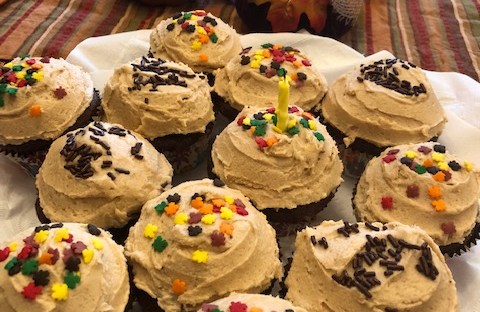
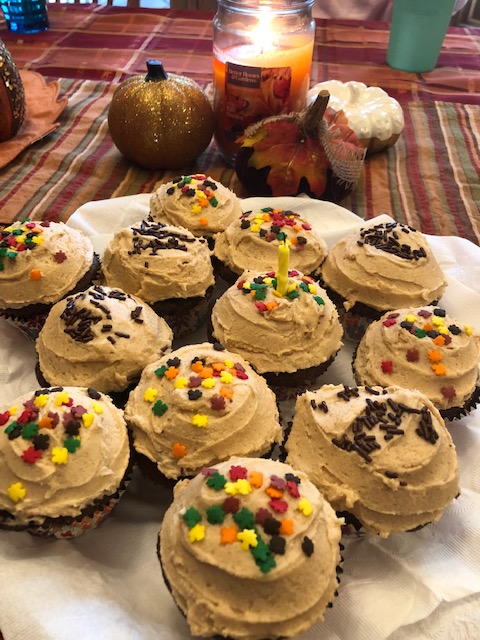
Autumn cupcake photos
My mom’s hard work at last year’s birthday celebration. Dark chocolate and peanut butter is my favorite!

So there again, just a few ideas for everyone and some suggestions for participating and staying on this pain-in-the-neck wagon.  For more great recipes and ideas, I recommend checking out this great post from the Martha Stewart website and from Taste of Home. Seriously-check these out. There’s over one hundred different recipes here!

I’d LOVE it if you’d like to share some of your recipes and suggestions here too-we can ALL, ALWAYS use ideas for making this life easier and just a little sweeter (sorry-couldn’t resist!). 

Love and Light,


Megan C.


For Family & Friends, Type 1 Diabetes

Sometimes We Lose Someone

Alarm bells greeted me as the elevator doors opened.

The waiting area was the typical hospital scene. Aging copies of Home & Garden and Popular Mechanic were strewn about over tired coffee tables. Those were surrounded by haphazard chairs and one sad television playing the local weather on an endless loop.

Added to the mix were my brother and father. They were both milling about anxiously and looked like they had been crying, or were about to.

I instantly knew what was going on.

“That’s her,” my brother confirmed.


After decades as a Type 1 Diabetic, my mother’s health had been steadily deteriorating due to issues with her heart and kidneys. She had been in and out of the hospital for months, but this time had felt different.

She’d begun to collect fluid in her legs and eventually her lungs as a result of the heart and kidneys struggling to function properly. This made breathing a challenge, but options were limited as any solutions would tax her already overburdened systems.

About 10 minutes before I walked through those elevator doors she had gone into cardiac arrest.

After a few numb minutes as the latest member of our strange family gathering, the doctor came out with a forlorn look on his face. He explained that they were still working on her, but that they hadn’t had any success to that point.

I knew they needed to stop and said something to that effect out loud. My Dad tearfully agreed. The doctor attempted to console us as best he could. I remember he hugged us both. I think my brother had snuck off towards the room. 


This is an outcome that I would imagine many in this community don’t care to think about. I don’t blame anyone for that. I also know that it’s important to confront the realities of the potential negative outcomes of this disease, both for patients and caregivers alike.

Seeing the things I’ve witnessed has only heightened my previous concerns with respect to caring for my fiancé. It adds some strain to keeping the balance between being a concerned partner and not being overbearing.

I always worry, but I also know Megan is a brilliant, fully formed adult who has been living successfully with T1D for nearly 30 years.   

I’ll always remember my final conversation with my mother. She was struggling to speak but when she found out that Megan had come to the hospital and was out in the same waiting area we’d be in the next night, she gasped between breaths that I needed to take care of her and get her home.

She was more concerned with Megan’s oft-embattled immune system than her own.

Finding the right blend of concern and trust is a difficult thing, and something I’ll probably write about in the future. It’s an ongoing battle, but one that’s unquestionably worth fighting. 

For Diabetics, For Family & Friends, For Medical Professionals, Type 1 Diabetes, Uncategorized

Birthday & Celebration Foods: Part 1 of 3

Having recently celebrated a big birthday myself, as well as the birthdays of many people close to me and having recently attended several bridal events and a wedding, I feel qualified to say the food in our culture is vast and abundant.  While this is an exciting thing, it’s also a major challenge for those of us living with sub-par pancreases.

That said, there is no reason to fret! We just have to find ways to participate that aren’t damaging and make decisions about the types and amounts of risk or hurt we’re willing to take.

I recently had a great conversation about this with my soon-to-be-aunt, Melissa,  at a birthday celebration for my soon-to-be-grandmother-in-law (all those hyphens!). We were talking with Melissa’s mom (not the soon to be GMIL), who is a type 2 diabetic and does pretty well overall with managing her diet and medications.

Melissa had some great concerns and questions about how I decide what to do in special occasions where there are things like birthday cake.   Melissa, her mom, and I had a very honest conversation about the challenges surrounding food choices, and how important it is to be able to participate and “live” rather than just “survive”.

(Melissa also asked me when I was posting here again.  I’m thinking once a week, or an every other week schedule for posts moving forward.  Either way, thank you for the question and affirmation someone’s reading Melissa!)

So, how do we decide what’s important enough to risk the cake?

I ask myself a few questions as I’m making these decisions, and I like to think they are good ones:

  1. What’s the event?  
    1. Making it 7 days without cake is probably not a good reason to eat some.  That said, sometimes I just want cake. It’s about the balance factor for me really, and I try not to double down on desserts in a day or weekend if I can help it.  Generally, birthdays, weddings, retirement parties, etc. (you know, major life things), are celebratory times where I’ll strongly consider participating in dessert.
  2. What else did I eat today? 
    1. She who ate an ice cream cone 2 hours ago shall not eat birthday cake now, unless she A) WENT RUNNING OR GOT OTHER STRENUOUS EXERCISE or B) IT IS HER BIRTHDAY or C) SHE’S JUST DOING THE “WRONG” THING, DAMMIT.  In all seriousness though, I treat my days and weeks as a sliding scale. If I did a dessert earlier, there is a strong possibility of me not doing anything like that now without an A, B, or C factor at play.
  3. How do I feel now? How do I predict I’ll feel later?
    1. This question is a good one for checking in with the total picture of health. Am I overly full? Am I eating this because I want to, or because I feel a social obligation? What kind of dessert is this? What do I know about my reactions to this from previous experiences?  How bad will I regret this later, one way or another? Fear of Missing Out (FOMO) is real, and diabetes is extremely good at providing FOMO, so I include that in my prediction questions?
  4. What is my blood sugar like right now?
    1. This one feels a little self explanatory, but it really does make a difference. I don’t like to eat some desserts when my blood sugar is low, for instance, because I know I’ll be inclined to over eat.   I generally don’t participate if my blood sugar is actually high (versus “just after dinner” high, which is in the 200s for me).
  5. Do I know what’s in this dessert? Are there options to lessen the damage? 
    1. SO IMPORTANT.  Ask the question, “What’s in this?”  You may be surprised.  This is important to know for bolusing/injections and answering many of the other questions here.  Also, if you’re like me and the people in your life know you’re diabetic, they may be doing swaps (Splenda instead of sugar, applesauce, etc.) to be helpful and that can seriously impact the carb-count.
  6. What are the social/emotional/mental factors here?
    1. Let’s be blunt: #diabetesisaprick and there are days where the dessert sounds good, or the guilt feels bad, for the wrong I try to check in with these factors to make sure I’m eating things I truly enjoy and doing it for the right reasons.  Binge-eating cake because we’ve had a bad day is NOT enjoying a social gathering with family to celebrate someone you love. It just isn’t. Sorry.

So, these are some baseline questions to use when making food choices.  But at the end of the day, I’ll share here what I shared with Melissa and her (absolutely wonderful and very-on-top-of things) mom.

“We do the best we can with what we have, because it is all we can do.” 

That’s it. There’s not another secret recipe or motto that has served me more in these situations, or in moments where I’m making self care decisions.

Stay tuned for Part 2 of this post, where I’ll share recipes and alternative food ideas for when we want to celebrate “on the wagon” instead of getting off and trying to get back on post-celebration.

Sending Love and Light,


Megan


P.S. Do you have something great you want to share with the online diabetes community? Have a story or idea you think could be helpful? Send them over! These communities work best when they are interactive communities, and there are people everywhere that can benefit from your story, whether you’re a diabetic, a care provider, a member of the medical community, or a family member or friend.  Send them to us at megan@thefriendlyneighborhooddiabetic.com (Justin can look at that one too!).

Depression, For Diabetics, For Family & Friends, For Medical Professionals, Type 1 Diabetes, Uncategorized

I’m Free! Start and End Dates Part 2.

I’M FREE.

Guys, it’s been two, TWO, whole days since my thirtieth birthday and I’m still here.

WE MADE IT!

I’m so excited to be starting this new chapter of my life; this chapter without a set end date. I’m free from those prognoses dates and I truly feel different as I go into my thirtieth year.

As part of my diabetes treatment plan, I work with a therapist who helps me keep my mental health in check so I can keep my physical health in check. I’m a firm believer that we have to care about our mental well being just like we have to care about our physical health.  There will be several posts about this in the near future.

When I walked in yesterday for my appointment, she said, “Hey! You don’t look dead to me. Congrats!” (She’s awesome and that sense of humor is one of the several things we have in common.)

She’s very right. I’m very much alive.

Riding that high, I took some time Thursday through today to really reflect on my life and how fortunate I am. I did some tough reflecting on how it all has gone and what I’m doing with the next many years of my life. I took a moment of silence and prayer for the people I lost along the way, as there have been several and each birthday and diabetes diagnosis anniversary reminds me that others weren’t so fortunate.

I don’t know what would have been easier. My future mother-in-law passed away in December from complications from Type 1 Diabetes. She was diagnosed in her early thirties after she’d had her two boys and had been living her life eating and doing what she wanted.  When she passed, her and I had had diabetes for about the same amount of time.  It’s hard for me to imagine being diagnosed as an adult and having to adjust an entire life around something that I didn’t know anything about until I had it. I know people do it, but in some ways, I do feel my situation was more fortunate.

That said, I don’t remember life before this disease, but I know from reflecting and living it and working through some of it with my therapist that growing up with it had its own challenges. I know that my physical development was impacted by diabetes and that my psychological and emotional development was hammered on by type 1 diabetes.

I know that by the time I was graduated high school, I had lost several close friends from the thing I was constantly being told would ultimately kill me. I remember waking up at age 9 after a very serious low blood sugar in the back of my parent’s mini van at an amusement park where I had crashed.  I know that I experienced survivor’s guilt for the first time when I was 11, and I’d experience it many more times in my life.  I remember being 14 on a school chorus field trip and we went to sing to the patients in the dialysis lab; I came back to my mom’s office after school and sobbed into her arms because I felt so afraid.  I know that at 29 I watched the man I love struggle with the loss of his mother from the same disease his future wife has.

I don’t mention all of these things in what is ultimately supposed to be an upbeat post because I’m garnering your sympathy. Instead, I list these things out to try to reflect on the things I lived through in this first thirty years of my life. I’m considering these experiences building blocks for whatever is coming. If you believe in the butterfly effect, I had to be a diabetic in order to live this life, and I had to have everyone of these losses and scares to be here now, writing to all of you.

I’ve said it before, and I’ll say it again; I’m so fortunate. My diabetes gave me a purpose and a platform and a complex and a lot of good things and a lot of not as great things.  My diabetes made me the person I am, and at thirty I’m really starting to like me.  When I talk about being grateful for this life, I truly don’t know how or why I was born this lucky. But I believe my diabetes, the people I’ve met, helped, known, loved, and the things I’ve experienced, are absolutely a part of the reason I’m here. On Earth, still existing despite being told how extremely unlikely it was that I wouldn’t.

I’m still finding my purpose, but I’m excited to live life without an end date.  I’m going to take this next year and rock it.

If you’re interested in sharing what you’re going to do with this next year, we’re all ears here. Send me an email, share a comment on the post, or message or post to us on Facebook. This life is most fun with all of us in it. 

With Love and Light,

-Megan C.